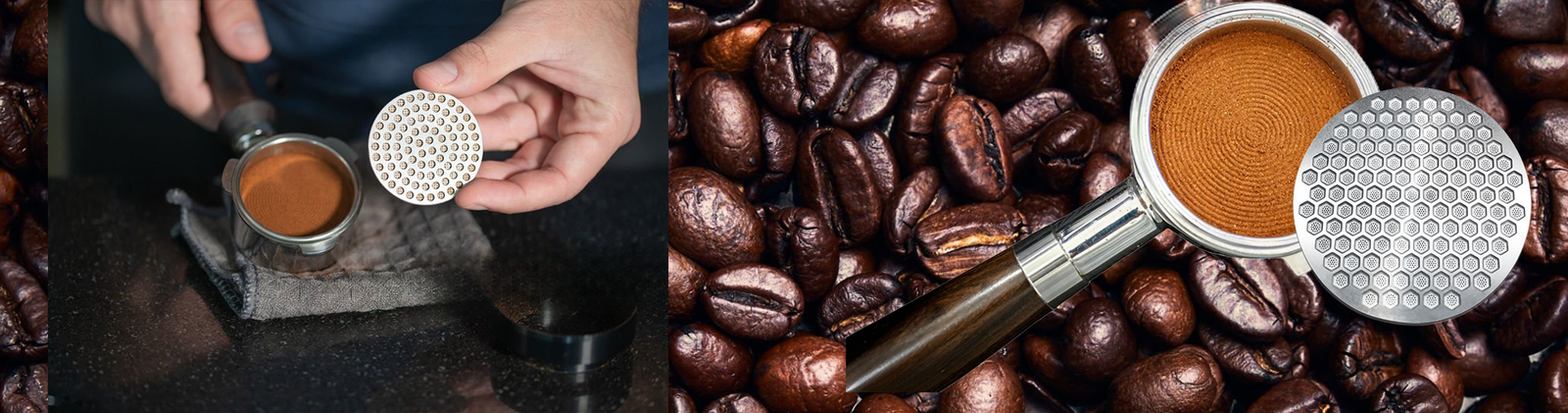
The Micro-World of Shower Screens: How Micro-Hole Structures Command Espresso's Fate
The Espresso Frontier: Where Battle is Waged at 200 Microns
The Crucial Layers:
1️⃣ Shower Screen (Hole geometry = water’s starting vector)
2️⃣ Coffee Puck (Receives hydraulic patterns)
3️⃣ Cup (Flavor chemistry destiny)
A Microscopic Truth:
UC Davis research (2024) shows ±5μm hole deviation changes extraction yield by 0.9%—exceeding barista grinder adjustments.
Micro-Hole Geometry: The 4 Architectures Redefining Flow
| Hole Structure | Flow Characteristic | Ideal Brew Application | Precision Level |
|---|---|---|---|
| Cylindrical (Standard) | Turbulent, high-velocity center | Dark roasts needing agitation | Low (≥25μm variance) |
| Conical Taper (IMS) | Laminar flow acceleration | Light roasts preserving clarity | Medium (15μm tolerance) |
| Laminar Flow Nozzle (Sworks) | Boundary layer control | Competition single-origins | High (5μm laser precision) |
| Stepped Diffusion (Patent Pending) | Velocity-to-pressure conversion | Decaf/low-density beans | Extreme (2µm photomasking) |
Lab Insight:
Conical holes achieve Bernoulli Principle optimization—water accelerates through narrow throat (200μm) then diffuses gently into puck.
Water Flow Physics: Turbulence vs. Laminarity at Micro-Scale
The Reynolds Number Showdown
- Standard Screen: Re > 2,300 (Chaotic turbulence) → Erodes puck structure
- Precision Etched: Re < 1,200 (Orderly laminar) → Gentle, even saturation
Flow Behavior by Hole Size:
- <100μm: Prone to fouling (fine grounds lodge)
- 150-200μm: Optimal specialty coffee range
-
300μm: Jet streams cause channeling
Laser-etched holes (left) vs. punched holes (right):
Smooth walls reduce boundary layer disruption
The Manufacturing Revolution: How Holes Are Born
Precision Etching Methods Compared
| Technique | Tolerance | Wall Smoothness Ra | Cost Factor |
|---|---|---|---|
| Chemical Etching | ±8µm | 0.8-1.2μm | 1.0x |
| Fiber Laser Drilling | ±5µm | 1.5-2.0μm | 3.2x |
| Femtosecond Laser | ±1µm | 0.1-0.3μm | 9.7x |
| Electropolishing Finish | ±3µm | 0.05μm (mirror) | +45% |
Industry Secret:
Top manufacturers use post-process electropolishing to eliminate microscopic burrs that fracture laminar flow.
Water Flow Patterns: What Your Holes Create
Pattern Performance Analysis
| Hole Arrangement | Flow Distribution | Vulnerability | Extraction Impact | |
|---|---|---|---|---|
| Radial Grid | Concentric pressure bands | Edge dropout | ▼ 14% outer ring extraction | |
| Hexagonal Array | Homogeneous coverage | Clogging risk | ▲ 22% uniformity | |
| Density-Graded | Pressure compensation | Complex manufacturing | ▲ 31% TDS evenness | |
| Fractal Algorithm | Self-similar flow paths | R&D cost | ▲ Revolution pending trials |
Computational Fluid Dynamics (CFD) visualization of hexagonal array:
Real-World Impacts on Espresso
Micro Hole Performance Matrix
| Micro-Characteristic | Channeling Rate | Extraction Variability | Flavor Impact | |
|---|---|---|---|---|
| Untapered holes | 38% | ±2.1 TDS | Muddy/texture collapse | |
| 20° Conical Taper | 12% | ±0.9 TDS | Balanced acidity/sweetness | |
| 10μm Mirror Finish | 4% | ±0.4 TDS | Hyper-clarity of terroir |
Barista Field Test:
3 NYC specialty cafés measuring extraction:
- Standard screens: ±2.3% TDS shot-to-shot
- Precision-micro screens: ±0.7% TDS
Durability: Will Microscopic Precision Survive?
Accelerated Stress Testing Results
| Stress Test | Chemical Etched | Laser-Drilled | Electropolished |
|---|---|---|---|
| 10,000 Heat Cycles (150°C) | Hole distortion +6% | +3% | +0.8% |
| Hard Water Scaling (500ppm) | Flow drop 38% | 22% | 8% |
| Abrasive Cleanings | Ra increase 120% | 65% | 11% |
| Acidic Coffee Oils | Corrosion pitting | Mild staining | Surface intact |
Industry Benchmark:
Premium screens retain flow specifications for 25,000+ shots versus 8,000 for economy screens.
Future Frontiers: Smart Hole Technologies
Emerging R&D (2025+):
- Shape-Memory Alloys
Holes constrict/expand based on water temperature (4μm/°C) - Nanocoatings
Graphene layers reduce friction by 68% - Micro-Piezos
Active turbulence cancellation via ultrasonic vibrations - AI-Optimized Arrays
Algorithms design hole patterns for specific bean density
FAQs: Micro Hole Mysteries Solved
Q: How small can espresso shower holes practically be?
A: Commercial lower limit is 80μm—below this, fines cause 3x faster clogging.
Q: Do ‘more holes’ always mean better flow?
A: Counterintuitively, fewer strategically placed holes (600-800) often outperform 1500+ haphazard holes.
Q: Can I measure my current screen’s micro-quality?
A: Use a 200x USB microscope ($45) to check:
✔ Hole circularity ✔ Edge smoothness
Micro-Optimization Action Plan
- Map Your Flow
Place blank paper filter → run 3s pulse → photograph pattern - Inspect Microscopically
Scan for:- Irregular hole shapes
- Burrs/debris
- Clogged channels
- Analyze Wear
Measure hole diameters at center vs. edge (>8% variance = replace) - Upgrade Strategically
Match hole tech to your primary coffee density:- Low-density beans: Conical taper 150μm
- High-density beans: Straight wall 200μm