Shower Screen’s Influence on Espresso Machine Thermal Stability
In espresso preparation, precision is everything — and few factors are as decisive as temperature stability. Even a fluctuation of one or two degrees can shift flavor balance, alter crema formation, and undermine the consistency that defines professional coffee service.
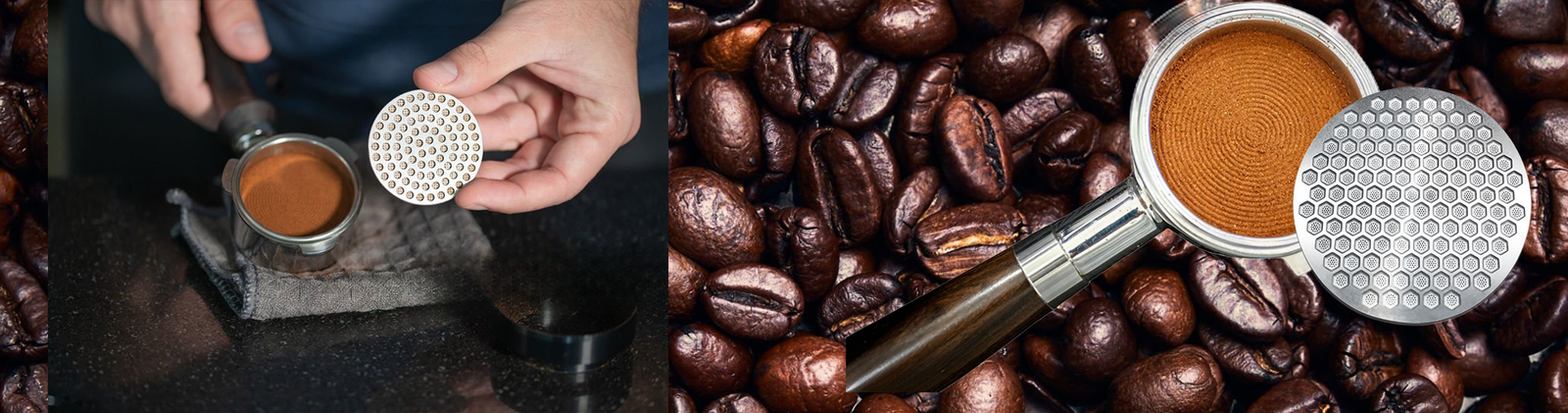
Among the components that determine this stability, the espresso shower screen plays a surprisingly important role. Sitting just beneath the group head, it’s the final thermal barrier before water contacts the coffee puck. The material, mass, and design of this small part directly affect how evenly and efficiently heat is transferred during extraction.
At Caffepress Precision Technology Co., Ltd., we specialize in manufacturing chemical-etched shower screens and espresso puck screens with micron-level accuracy. In this article, we’ll explore how the choice of screen material, structure, and production process can improve your espresso machine’s thermal stability — and why attention to this detail is essential for roasters, café chains, and equipment importers.
Understanding Thermal Stability in Espresso Machines
Thermal stability refers to an espresso machine’s ability to maintain a consistent water temperature throughout extraction. The goal is simple: to ensure that the water hitting the coffee puck stays within a narrow target range — typically 92–94 °C.
However, real-world conditions challenge this precision. Heat loss occurs at several points:
-
Between the boiler and the group head
-
Through the portafilter and basket
-
Across the shower screen into the puck
The Specialty Coffee Association (SCA) has found that even a 1.5 °C drop at the group head can reduce extraction yield by up to 5 %, leading to weaker body and underdeveloped flavors. This makes every component that touches the brewing path critical to temperature control — including the shower screen.
The Shower Screen’s Role in Heat Transfer
The shower screen serves two purposes: distributing water evenly and stabilizing temperature at the puck interface. When water exits the group head, it first contacts the metal shower screen, which then diffuses it through hundreds of tiny holes.
If the screen’s thermal conductivity is too low, it can act as a heat sink, cooling the water before it reaches the puck. If it’s too thin, it may fail to retain enough heat between extractions, causing the first shot after idle time to run cold. Conversely, a well-engineered screen with good thermal mass helps absorb short-term fluctuations and maintain consistent heat delivery.
In short:
-
High conductivity → faster heat recovery.
-
High mass → better temperature retention.
-
Uniform dispersion → even heating of the puck.
Material Science: How Composition Affects Thermal Behavior
Choosing the right material for the shower screen is one of the most effective ways to improve thermal consistency.
304 vs 316 Stainless Steel
Both are widely used in espresso manufacturing, but with subtle differences:
-
304 SS: Reliable, cost-efficient, and offers good thermal performance (≈14–16 W/m·K).
-
316 SS: Contains molybdenum, improving heat conductivity (≈16–17 W/m·K) and corrosion resistance—ideal for high-humidity or soft-water environments.
Brass and Legacy Materials
Older commercial machines often used brass shower plates, valued for conductivity (≈110 W/m·K) but less favored today due to oxidation and lead-free compliance issues.
Titanium-Coated Stainless Steel
Premium models now adopt titanium coatings, which enhance surface hardness, resist corrosion, and stabilize surface temperature during rapid heating cycles.
Table – Material Comparison
| Material | Thermal Conductivity (W/m·K) | Corrosion Resistance | Durability | Typical Use |
|---|---|---|---|---|
| 304 SS | 14–16 | High | Excellent | Standard screens |
| 316 SS | 16–17 | Very High | Excellent | Premium/OEM |
| Brass | 110 | Moderate | Good | Legacy machines |
| Titanium-coated SS | ≈15 | Excellent | Exceptional | Custom designs |
How Chemical Etching Enhances Temperature Consistency
At Caffepress, we employ photochemical etching instead of punching or laser cutting. This process dissolves precise patterns into stainless-steel sheets using controlled chemical reactions. The advantages are both structural and thermal:
-
Uniform Micro-Holes – Consistent water dispersion avoids localized cooling spots.
-
No Burrs or Warping – Smooth edges maintain intimate contact with the group head, minimizing micro-gaps that cause heat loss.
-
Thin Yet Stable Profiles – Our etched screens can be as thin as 0.20 mm while preserving rigidity, allowing fast thermal response without deformation.
A recent case study with a European distributor showed that switching from a punched 304 SS screen to a 316 SS chemically-etched model improved thermal stability by 0.8 °C during 10 consecutive extractions on a dual-boiler machine. The result: more consistent crema and reduced shot-to-shot variation.
Furthermore, etching allows custom hole geometry and density distribution, enabling roasters to fine-tune heat transfer and flow resistance simultaneously.
Testing Thermal Stability – What to Measure
Thermal stability isn’t guesswork—it’s measurable. Professional equipment testers and baristas often use the following tools:
-
Thermocouple sensors inserted in the group head or portafilter.
-
Scace devices, which simulate espresso flow while logging temperature and pressure.
-
Smart data loggers, offering shot-to-shot temperature curve visualization.
When evaluating shower screens, key indicators include:
-
Steady-state temperature variance – ideally < ±0.5 °C across 10 shots.
-
Recovery time – how quickly the group head returns to target temperature after each extraction.
-
Uniformity – minimal gradient across puck surface, ensuring balanced flavor extraction.
Balancing Performance and Practicality
Every design choice is a compromise between thermal performance, durability, and maintenance.
-
High-mass screens store more heat but take longer to warm up.
-
Thin etched screens respond faster but may cool quicker if idle.
-
Smooth etched surfaces resist scale, reducing temperature loss caused by residue buildup.
-
Proper preheating of the portafilter and screen before the first shot ensures consistent temperature from start to finish.
For baristas and importers, the key is matching the screen’s design to the machine’s heating system. Single-boiler machines benefit from lightweight, responsive screens; dual-boiler or saturated-group systems perform better with heavier, thermally stable variants.
Practical Advice for Baristas and Equipment Importers
-
Preheat Everything: Warm up the portafilter, basket, and shower screen before the first espresso of the day.
-
Check Flatness: A warped screen creates gaps that cause heat and pressure inconsistency; replace regularly.
-
Select Materials Carefully: For coastal or humid markets, 316 SS offers longer life and stable performance.
-
Specify Details to Manufacturers: Provide target machine models, brew temperature range, and extraction goals when ordering OEM parts.
-
Verify Certification: Request documentation for food-grade compliance and stainless-steel authenticity (SS 316 certificate).
Caffepress’s Engineering for Temperature Precision
At Caffepress Precision Technology Co., Ltd., our Dongguan factory is equipped with temperature-controlled etching lines, ensuring consistent hole geometry and sheet thickness.
Manufacturing Highlights:
-
Flatness tolerance ≤ 0.02 mm for perfect contact.
-
Etching precision ± 0.01 mm for uniform heat diffusion.
-
Available materials: 304, 316, and titanium-coated stainless steel.
-
Optional dual-layer construction for additional thermal inertia.
-
Branding options: laser-engraved logos for OEM partners.
Each batch undergoes dimensional and surface-temperature consistency tests before shipment, backed by ISO 9001 and SGS certifications. With over 15 years of export experience, Caffepress supplies major distributors and roaster chains across Europe, North America, and Asia.
Conclusion – Small Component, Big Thermal Impact
The shower screen may be one of the smallest components in an espresso machine, but its impact on thermal stability is undeniable. The right combination of material, thickness, and etching precision ensures that every drop of water arrives at the coffee puck at the correct temperature — resulting in balanced flavor and predictable extraction.
For professionals seeking consistent performance, upgrading or customizing the shower screen is an efficient and measurable improvement.
Caffepress provides precision-etched, thermally optimized espresso shower screens for global OEM clients and coffee-equipment brands. Partner with our Dongguan team to design a screen that matches your machine’s thermal profile and elevates every shot.
Frequently Asked Questions
1. How does shower screen material affect espresso temperature?
Metals with higher thermal conductivity stabilize brewing temperature by reducing short-term fluctuations between shots.
2. Is 316 stainless steel better than 304 for heat retention?
Yes. 316 SS offers slightly higher conductivity and superior corrosion resistance, making it ideal for high-humidity environments or commercial usage.
3. Does chemical etching influence temperature control?
Absolutely. Etching produces uniform micro-holes that disperse water evenly and maintain stable surface temperature across the puck.
4. How can I test my machine’s thermal stability?
Use a thermocouple or Scace device to monitor temperature during extraction and compare shot-to-shot consistency.
5. Can Caffepress produce OEM shower screens for my brand?
Yes. Caffepress offers full OEM customization in size, material, logo engraving, and dual-layer designs to fit any commercial espresso machine.