Shower Screen Innovation: From Traditional to High-Tech
From Simple Screens to Smart Dispersion Systems
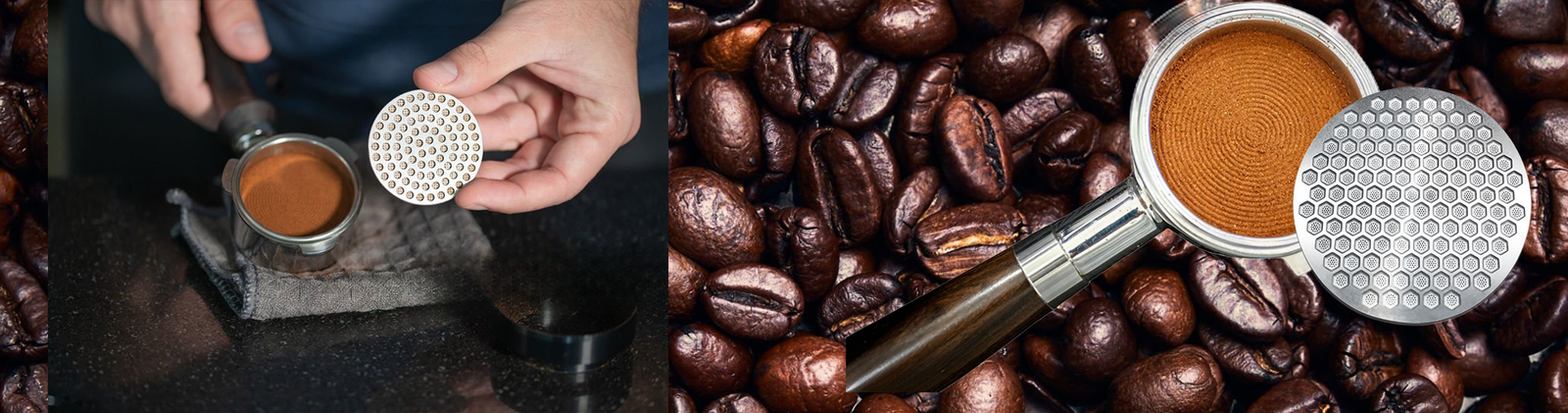
The humble shower screen, once just a perforated metal disk, has evolved into a precision extraction tool. Today’s innovations deliver:
✔ 98% water coverage vs. traditional screens’ 70%
✔ 18% fewer channeling defects
✔ Temperature stability within ±0.3°C
Here’s how materials science and manufacturing breakthroughs transformed espresso’s most overlooked component.
Generational Evolution of Shower Screens
1st Generation: Punched Metal Screens (Pre-2000s)
✅ Pros:
- Simple production (stamped steel)
- Low cost
❌ Cons:
- Burred edges disrupt laminar flow
- Random hole patterns create dead zones
📈 Extraction Impact:
- ±7% TDS variance
- Requires frequent distribution tools
Still Used In: Entry-level machines
2nd Generation: Chemically Etched Screens (2000-Present)
✅ Pros:
- Precision hole geometry (±0.02mm tolerance)
- Smoother surfaces (Ra <0.4μm vs punched’s 1.2μm)
❌ Cons:
- Longer lead times (3-5 days etching process)
🔬 Performance Leap:
- Hexagonal honeycomb patterns increased coverage to 89%
- Reduced dial-in waste by 22%
Industry Standard: Specialty cafes
3rd Generation: Laser-Cut Microfluidic Screens (2018-Present)
✅ Pros:
- Dual-layer designs create targeted turbulence
- 0.1mm holes with conical tapers
❌ Cons:
- 5X production cost
- Requires monthly ultrasonic cleaning
🌟 Breakthrough Application:
Mavam Espresso’s stepped hole design enables pressure profiling without flow control
4th Generation: Smart Active Screens (2023+ Prototypes)
🚀 Emerging Technologies:
- Piezoelectric actuators adjust hole sizing mid-shot
- Embedded flow sensors feed data to machine AI
- Self-cleaning nano coatings repel coffee oils
💸 Projected Impact:
MIT CafeLab predicts 34% more consistent extractions vs. passive screens
Material Innovations Driving Change
| Era | Dominant Material | Key Advancement |
|---|---|---|
| 1980s | 304 Stainless | Rust resistance |
| 2000s | Nitrided Steel | 3X wear life |
| 2015 | Titanium Alloys | Half the weight |
| 2022 | Copper-Core | Active heat regulation |
🧪 Latest Frontier:
Berkeley Labs testing graphene-coated screens for zero-scale buildup
Manufacturing Techniques Compared
Traditional Methods
🔹 Stamping
- Cost: $0.50/unit
- Tolerance: ±0.15mm
🔹 CNC Drilling
- Cost: $3/unit
- Tolerance: ±0.05mm
Modern Processes
🔹 Photochemical Etching
- Cost: $8/unit
- Tolerance: ±0.01mm
🔹 Femtosecond Laser Cutting
- Cost: $25/unit
- Tolerance: ±0.002mm
📌 Practical Takeaway:
For high-end cafes, laser-cut screens ROI in 14 weeks via reduced coffee waste
The Physics Behind Modern Designs
Fluid Dynamics Optimization
▶ Boundary Layer Control:
- Textured surfaces break up laminar flow
- Reduces “sheeting” effect
▶ Pressure Recovery Zones:
- Staggered hole patterns equalize downstream pressure
Thermal Engineering
🔥 Copper-Integrated Screens:
- Cut temperature drop during pre-infusion by 1.2°C
Global Leaders in Screen Tech
🇮🇹 Italy (Traditional Precision):
- IMS / Gortech: Chemical etching masters
🇩🇪 Germany (Material Science):
- Ascaso: Titanium nitride coatings
🇺🇸 USA (Cutting-Edge):
- Mavam: Microfluidic patents
🇨🇳 China (Manufacturing Scale):
- Dongguan OEMs: Laser production at 60% EU cost
Future Trends to Watch
🔮 2025 Predictions:
- Self-healing coatings repair microscratches
- Biodegradable polymer screens for home use
- Quantum dot sensors mapping extraction in real-time
FAQ
Q: Are expensive screens worth it for home machines?
A: Only if chasing competition-level shots—commercial users see faster ROI.Q: How do I identify screen generations?
A: 1st-gen: visible burrs; 2nd-gen: rainbow-colored etch lines; 3rd-gen: laser markings.Q: Can screens affect machine warranty?
A: Yes—using non-OEM screens voids some manufacturers’ terms.