Quality Control in Precision Etching: Ensuring Consistency in Every Shower Screen
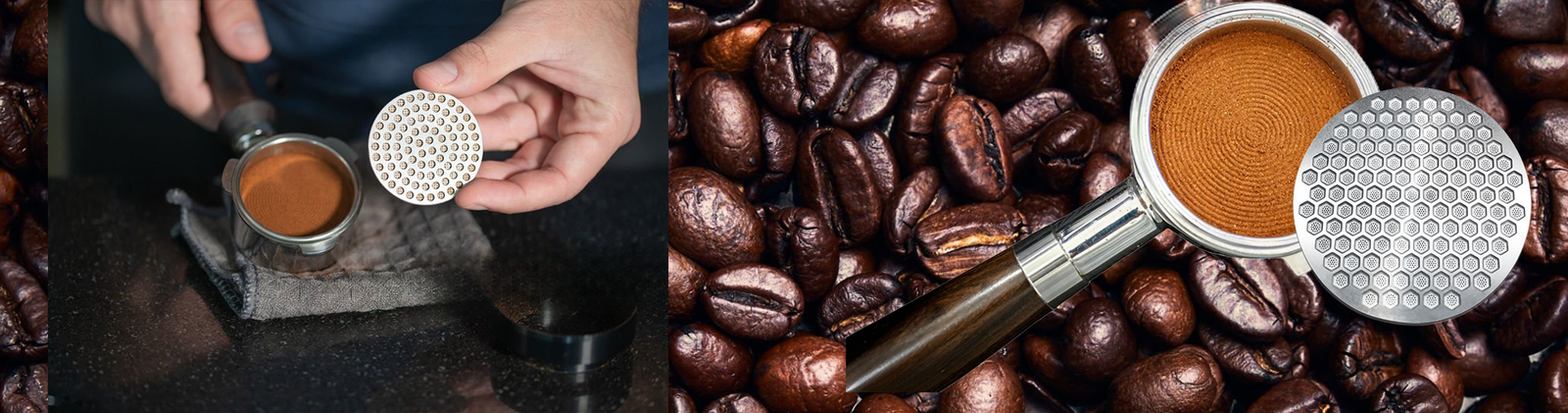
Behind every perfectly balanced espresso shot lies not only skilled craftsmanship but also technological precision. The espresso shower screen, though small, plays a vital role in controlling water dispersion, extraction uniformity, and thermal stability. To guarantee consistent quality in thousands of units, precision manufacturing must go beyond machinery — it must be driven by science-based quality control.
At Caffepress Precision Technology Co., Ltd., we understand that a single micron can change extraction performance. That’s why our precision etching process combines optical verification systems, machine-learning algorithms, and rigorous testing protocols to ensure every shower screen leaving our Dongguan facility performs identically — from the first piece to the last.
This article explores how modern quality control in precision etching safeguards reliability, consistency, and confidence for global coffee-equipment brands.
The Role of Precision Etching in Coffee Hardware
Chemical or photochemical etching allows manufacturers to produce micro-perforated stainless-steel components with extreme accuracy. Instead of punching or drilling, it uses controlled chemical reactions to dissolve metal precisely according to a photo-resist pattern.
For espresso shower screens, this means:
-
Uniform hole geometry for predictable water flow
-
Burr-free surfaces ensuring easy cleaning and better hygiene
-
Consistent thickness for stable heat conduction
Unlike mechanical stamping, etching leaves no residual stress in the material, guaranteeing both dimensional accuracy and surface integrity — essential for café machines that undergo thousands of heating cycles.
Why Consistency Is Critical
Espresso machine manufacturers and roasters depend on repeatable performance across batches. A deviation of only ±0.01 mm in hole size can alter flow rate, temperature retention, and extraction time.
For global distributors, inconsistency means not just flavor variation but also costly brand risks. Thus, every Caffepress shower screen must meet three uncompromising criteria:
-
Dimensional uniformity across the entire etched sheet.
-
Optical alignment of hole geometry for even water dispersion.
-
Surface stability to ensure easy cleaning and long service life.
Step-by-Step Quality Control Workflow
1. Incoming Material Verification
Each batch of 304 or 316 stainless steel is certified for chemical composition and thickness tolerance. Samples are tested using:
-
X-ray fluorescence (XRF) to verify alloy grade.
-
Micrometer calibration for thickness uniformity (±0.005 mm).
-
Visual inspection for surface impurities or oil residues.
Only verified raw sheets proceed to photo-resist coating.
2. Photolithography Accuracy Check
During pattern transfer, precision masks define micro-hole positions. Alignment errors as small as 0.02 mm can cause uneven flow, so optical alignment systems are used.
Optical verification with high-resolution cameras detects deviations in:
-
Mask registration
-
Exposure uniformity
-
Photo-resist adhesion
Defective areas are flagged automatically and excluded before etching begins.
3. Controlled Etching and Real-Time Monitoring
Caffepress operates fully enclosed etching chambers that control:
-
Acid concentration
-
Temperature stability
-
Spray pressure and dwell time
Sensors feed live data to a machine-learning algorithm trained to identify abnormal etch-rate behavior. If deviation exceeds tolerance, the system adjusts chemical concentration instantly, ensuring consistency across the entire batch.
This combination of automation and algorithmic feedback reduces process variation by over 30 % compared with manual control methods.
4. Post-Etching Rinse and Surface Treatment
After etching, each sheet is neutralized, cleaned, and passivated. The goal: remove all residual chemicals while enhancing corrosion resistance.
Surface smoothness and reflectivity are verified through optical microscopy. Only screens with burr-free edges and mirror-level flatness (≤0.02 mm deviation) advance to the next step.
5. Automated Optical Verification
High-resolution imaging systems capture each shower screen at 10 µm pixel precision, analyzing:
-
Hole diameter distribution
-
Edge smoothness
-
Pattern uniformity
-
Flatness and concentricity
Defects smaller than 0.05 mm are detected automatically. This non-contact optical inspection ensures that 100 % of production meets design geometry before packaging.
6. Manual Sampling and Functional Testing
Even in an automated environment, human expertise remains crucial. Technicians perform:
-
Flow-rate testing under 9-bar water pressure
-
Thermal response measurement using infrared imaging
-
Visual checks for aesthetic uniformity and logo clarity
This hybrid approach — machine precision plus human judgment — guarantees both performance and craftsmanship.
Harnessing Machine Learning for Predictive Quality
Modern quality control extends beyond inspection — it’s predictive. Caffepress’s in-house system continuously learns from production data to anticipate deviations before they occur.
By correlating variables such as temperature drift, acid concentration, and nozzle pressure, the algorithm identifies subtle trends that precede defects. Early intervention keeps yield rates above 98 %, ensuring reliability and cost efficiency for large OEM orders.
Over time, this digital feedback loop improves process capability (Cpk > 1.67), meaning every new batch is statistically more stable than the last.
Traceability and Batch Certification
Every Caffepress shower screen carries a unique batch code linked to digital production records. Importers and roasters can trace:
-
Material origin
-
Etching parameters
-
Inspection results
-
Operator ID and date
This level of traceability provides confidence for OEM clients who require detailed documentation for ISO 9001 and SGS compliance audits.
Comparison: Precision Etching vs Conventional Punching
| Aspect | Precision Etching | Mechanical Punching |
|---|---|---|
| Hole Tolerance | ±0.01 mm | ±0.05–0.1 mm |
| Surface Finish | Burr-free, smooth | Distorted edges |
| Stress Impact | None | High residual stress |
| Design Flexibility | Complex micro-patterns | Limited shapes |
| Consistency | High (algorithm-controlled) | Variable (manual process) |
For espresso shower screens, etching’s consistency translates directly into uniform extraction and extended equipment life.
Building Confidence for Global OEM Partners
Caffepress supplies precision-etched shower screens to coffee-equipment brands across Europe, North America, and Asia. Our clients choose us not only for product quality but for reliability of process.
From prototype sampling to full production, each project includes:
-
Pre-production approval (PPA) reports
-
Flow-rate and flatness data sheets
-
Optical inspection images for reference
These documents give importers complete transparency and simplify quality audits when re-exporting to regulated markets.
Conclusion – Precision Etching Meets Precision Verification
In espresso hardware manufacturing, precision is not achieved once — it’s maintained every day. The strength of a factory lies not only in its technology but in its commitment to systematic quality control.
Through optical verification, real-time process monitoring, and machine-learning prediction, Caffepress Precision Technology Co., Ltd. ensures that every shower screen performs exactly as designed — identical in geometry, flawless in surface, and consistent in flow.
From the first cup of the day to the millionth shot brewed worldwide, our mission remains the same: deliver consistency, one micron at a time.
Frequently Asked Questions
1. What makes precision etching more consistent than punching or drilling?
Etching removes material chemically, not mechanically, eliminating deformation and guaranteeing uniform geometry.
2. How does optical verification improve quality control?
It captures micron-level images of each component, detecting deviations invisible to the human eye.
3. What role does machine learning play in Caffepress’s production?
Algorithms analyze sensor data in real time to predict and correct process deviations, ensuring stable output.
4. How consistent are Caffepress shower screens across large orders?
Dimensional variation remains within ±0.01 mm, verified through automated optical and manual sampling tests.
5. Can OEM clients access inspection records?
Yes. Each shipment includes full inspection documentation and batch traceability for audit and certification compliance.