Production Speed and Efficiency of Etched Shower Screens
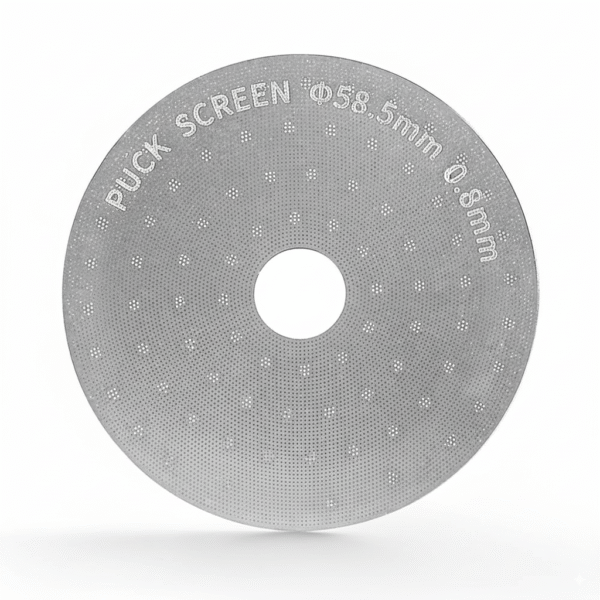
In specialty coffee, speed meets precision—whether pulling shots or manufacturing accessories. For espresso puck screens, production speed and manufacturing efficiency directly impact lead times, costs, and scalability.
At Caffepress, our chemical etching process balances rapid prototyping with high-volume mass production. This blog examines:
- How etching technology outperforms laser-cutting/stamping
- The role of automation in faster turnaround
- Why efficient production benefits global importers
Comparing Puck Screen Manufacturing Methods
| Method | Speed | Precision | Cost Efficiency | Best For |
|---|---|---|---|---|
| Chemical Etching | ⚡⚡⚡⚡ (Fastest) | ✔️ Micron-level | $$ (Mid-volume+) | Mass production |
| Laser Cutting | ⚡⚡⚡ (Moderate) | ✔️ High (~50µm) | $$$ (Tooling-free) | Prototypes/low volume |
| Metal Stamping | ⚡⚡ (Slow setup) | ❌ Limited by dies | $ (High-volume only) | Ultra-high volume |
Key Insight: Etching delivers the best balance—scalable for 10K+ unit orders without expensive tooling.
How Chemical Etching Maximizes Efficiency
1. Batch Processing (No Sequential Bottlenecks)
Unlike laser-cutting (1 screen at a time), etching:
- Processes hundreds of screens simultaneously in sheets
- Cuts production time by 60-70% vs. laser
Example: A 50µm-hole pattern takes 2 hrs/1000 units via etching vs. 8 hrs via laser.
2. Near-Zero Tooling Costs
- Stamping requires custom dies (5K–5K–20K)
- Etching uses digital masks (updated in hours)
Result: Faster rapid prototyping—new designs go from CAD to sample in 72 hrs.
3. Automated Quality Control
Post-etching, our vision systems:
- Scan every hole for consistency (%)
- Auto-reject warped sheets (0.01% defect rate)
This eliminates manual inspection delays.
Scaling Up: Mass Production Strategies
Optimal Order Quantities
- Prototyping: 50–500 units (5–7 days)
- Mid-volume: 1K–10K units (10–12 days)
- Mass production: 50K+ units (18–21 days)
Pro Tip: Combine orders quarterly to reduce per-unit costs.
How Importers Can Streamline Logistics
- Pre-book production slots (avoid peak-season delays)
- Standardize designs (minimize mask adjustments)
- Request bulk-pack options (faster palletizing)
FAQ
Q: What’s the minimum order for custom designs?
A: 50 units for prototyping; 1K+ for full production.
Q: Can you expedite shipping?
A: Yes—ask about air freight options for 5-day delivery.
Q: How durable are etched screens vs. stamped?
A: Equal lifespan—etching doesn’t weaken microstructure like stamping.
Conclusion
Chemical etching’s speed-to-precision ratio makes it ideal for espresso puck screens—whether producing first prototypes or 100K-unit shipments. For importers, this means:
✅ Shorter lead times (vs. stamped/laser-cut rivals)
✅ Cost savings at scale (no tooling)
✅ Flexibility (design tweaks without downtime)
Need a quote optimized for speed? Share your specs—we’ll match you with the best production tier.