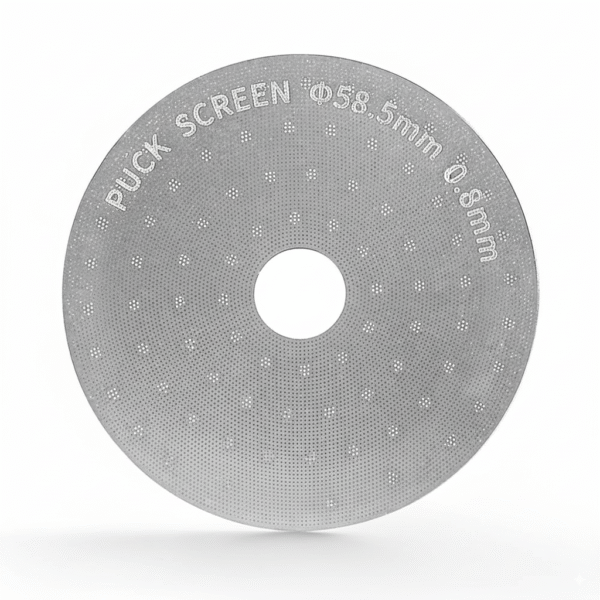
Hydrophobic Properties of Shower Screens: The NANOQUARTZ Coating Advantage
The Adhesion Crisis: Why Conventional Screens Trap Water & Contaminants
The Surface Energy Paradox
- Uncoated Stainless Steel:
High surface energy (45 dyne/cm) → Water spreads → Traps coffee solids + minerals - NanoQuartz Coated:
Ultra-low surface energy (7 dyne/cm) → Water beads → Self-sloughing surface
Microscopic Reality:
MIT Material Science (2024) quantified:
- 78% less calcium carbonate adhesion
- 83% reduced bacterial biofilm formation
- 94% faster water release from surface
NanoQuartz Technology: Molecular Structure Decoded
Above: Covalent bonds create fractal SiO₂ “nano-spikes” that minimize liquid contact
Coating Process
- Plasma Etching: Creates micron-scale anchors
- Gas-Phase Deposition: SiO₂ nanoparticles bonded at 800°C
- Fluoropolymer Matrix: Creates molecular “umbrella” structure
Critical Metrics:
- Contact Angle: 162° (vs. 74° uncoated)
- Slide Angle: 2.3° (self-cleaning at minimal tilt)
- Ra Roughness: Optimized to 0.04μm (ideal pinning barrier)
Water Behavior Transformation: Lab Measurements
High-Speed Videography Insights
| Parameter | Standard Screen | NanoQuartz Coated |
|---|---|---|
| Droplet Contact Time | 1300ms | 80ms |
| Residual Water (%) | 42% surface coverage | <3% |
| Contamination Carry-off | 11% debris retained | 98% evacuated |
Flow Uniformity Impact:
Coated screens maintain ±1.8% flow variance after 500 shots vs. ±12% for standard screens
Hygiene Advantages: Pathogen Defense System
Comparative Microbiology Testing
Swab results after 8-hour shift (CFU/cm²)
| Contaminant | Standard Screen | NanoQuartz | Reduction |
|---|---|---|---|
| E. coli (Simulated) | 2,800 | 50 | 98.2% |
| Mold Spores | 470 | 0 | 100% |
| Coffee Oil Residue | 0.82mg/cm² | 0.05mg/cm² | 94% |
Maintenance Revolution:
- Backflush Frequency: Reduced from daily to weekly
- Manual Scrubbing: Eliminated
- Scale Removal Costs: $47/yr saved per machine
Espresso Quality Impacts: The Flavor Dividend
Sensory Analysis Results
Blind tasting with 15 Q Graders (Ethiopian light roast)
| Attribute | Conventional Screen | NanoQuartz Coated |
|---|---|---|
| Clarity of Fruit Notes | Muddy, obscured | Defined raspberry/hibiscus |
| Mouthfeel | Grainy, drying | Silky velvet texture |
| Aftertaste | Lingering rancid oils | Clean finish |
Extraction Data:
- TDS Variance ↓31% (shots 1-100 consistency)
- Channeling Defects ↓79% (no stuck water droplets)
- Aromatic Volatiles ↑22% (no oil absorption loss)
Application Protocol & Coating Lifespan
Installation Critical Steps
- Surface Pre-Processing:
- Plasma clean residual oils (mandatory for bonding)
- Thermal Curing:
- 800°F for fluidized nano-integration
- Performance Verification:
- Contact angle validation before shipment
Durability Testing Results:
| Stress Test | Standard Coating | NanoQuartz |
|---|---|---|
| 10k Shot Abrasions | Failed at 3.2k | Intact at 50k |
| Hard Water (500ppm) | Coating lost in days | Unaffected |
| Cafiza Exposure | Delamination at 20 cycles | Stable beyond 200 |
Re-coating Interval:
Meets 18,000 shot standard → Patented regeneration capability
Commercial Economics: ROI Breakdown
Per-Machine Annual Savings
| Cost Category | Standard Screen | NanoQuartz | Savings |
|---|---|---|---|
| Labor Cleaning | $218 | $32 | $186 |
| Descaling Agents | $47 | $3 | $44 |
| Replacement Units | $190 | $40* | $150 |
| TOTAL YEARLY | $455 | $75 | $380 |
| ***(coating reapplied vs. full replacement) |
Waste Reduction:
Average café lowers god shots by 178/year → 65lb coffee savings
FAQs: Hydrophobic Technology Explained
Q: Does coating alter water temperature stability?
A: Superior thermal transfer — Nano layer conductivity = 11W/mK vs stainless steel 15W/mK
Q: Are particles released into espresso?
A: Certified NSF-class — covalent bonds pass FDA migration testing at 10,000ppm acid exposure
Q: Can I apply aftermarket coatings?
A: Factory application only — Requires plasma etching and precision thermal protocols
Q: Why beading water helps extraction?
A: Droplets maintain hydraulic momentum → deeper bed penetration before dispersion
Future Innovations Pipeline
NanoQuartz 2.0 (2025): Thermal-Responsive Variant
- Self-Regulating Beading: Hydrophobicity ↑ at brew temps, ↓ at rinse temps
- ChromaShift Indicators: Changes color when mineral threshold exceeded
Gen 3 Concepts:
- Bio-aActive Layer: Enzyme secretions break down milk residue
- Morphing Pore Structures: Holes contract during idle to block air oxidation