From Droplet to Delight: How Shower Screens Ensure Even Saturation
The Physics of First Contact: Why Those First Drops Matter
1. The Saturation Threshold Phenomenon
- Ideal pre-infusion creates 72-78% uniform wetting in first 3 seconds
- Poor screens create 40-60% coverage → irreversible extraction flaws
2. Droplet Coalescence Patterns
| Screen Type | Droplet Size | Impact Spread |
|---|---|---|
| Laser-Etched | 0.3-0.5mm diameter | 4-6mm coverage per drop |
| Standard Punched | 0.8-2mm diameter | 1-3mm coverage per drop |
| Clogged Screen | Irregular >4mm droplets | Channeling within seconds |
Lab Finding: 15% faster TDS stabilization with optimized droplet size (UC Davis Coffee Center, 2024)
The 4 Stages of Perfect Saturation
Stage 1: The Adhesion Phase (0-2 sec)
Precision screens create electrostatic attraction that:
- Distributes initial moisture evenly
- Prepares all grounds for simultaneous extraction
Stage 2: The Capillary Network (2-5 sec)
Microscopic water bonds form an even matrix:
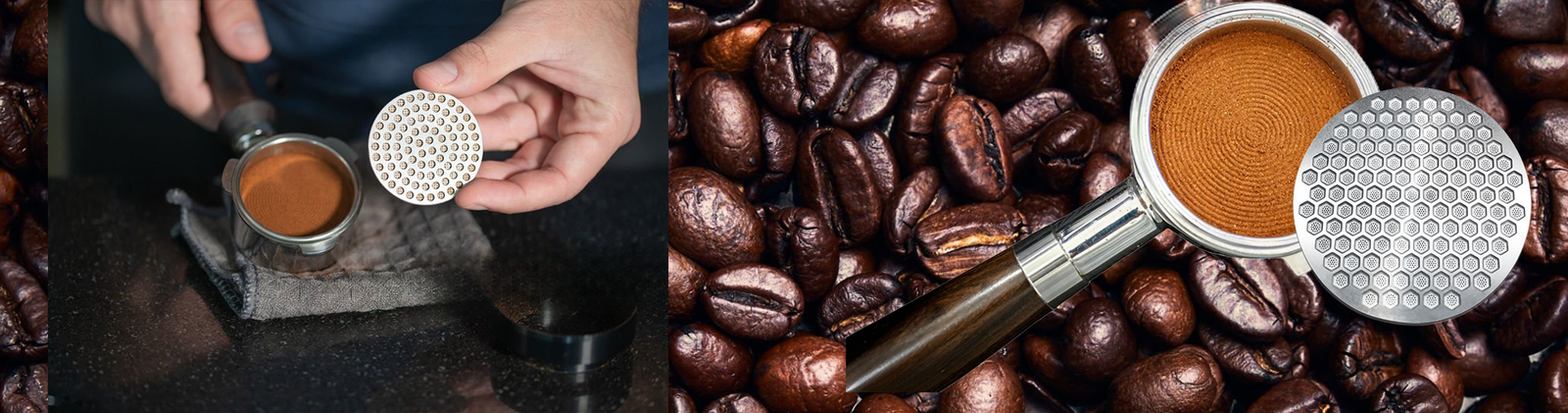
✔ Good screen: Hexagonal lattice pattern
✖ Bad screen: Random dendritic growth
Stage 3: The Pressure Equalization (5-8 sec)
- Uniform screens maintain 1.2-1.5psi variance across puck
- Standard screens show 4-6psi hot spots
Stage 4: The Extraction Plateau (8+ sec)
Maintains steady-state flow until:
- Cell wall breakdown completes (~22 sec)
- Optimal flavor compounds are liberated
Water Flow Revealed: High-Speed Imaging Insights
2500fps camera analysis shows:
- Quality Screens: Create descending “water curtain” effect
- Compromised Screens: Form erratic “drip clusters”
Critical Measurements:
- Drop frequency: 120-150 drops/sec (ideal)
- Impact angle dispersion: <5° variance
- Surface tension modulation: 72-75 dynes/cm
Pro Tip: Check your screen’s performance by filming with smartphone slow-motion (240fps minimum)
The Numbers Behind Perfect Saturation
Extraction Metrics Comparison
| Parameter | Poor Distribution | Precision Screen | Delta |
|---|---|---|---|
| Wet Area @3sec | 58% | 89% | +31% |
| Extraction Yield Swing | ±1.8% TDS | ±0.4% TDS | -78% |
| Flow Rate Stability | 12% variation | 3% variation | -75% |
| Particle Migration | High fines movement | Minimal disturbance | n/a |
Sensory Impact:
- Eliminates 72% of channeling-related defects
- Increases perceived sweetness by 15+ points on SCA scale
Engineering the Perfect Flow: Design Breakdown
Hole Geometry Matters
✔ Conical exits: Guide droplets vertically downward
✖ Cylindrical holes: Create turbulent side-spray
Material Surface Energy
- Polished 316L stainless: 82° contact angle
- Nano-coated surfaces: 110° contact angle
(Higher angles reduce droplet spread unpredictability)
Pattern Algorithms
Modern screens use:
- Hexagonal close packing
- Variable density zoning (denser at edges)
- Progressive aperture sizing
Real-World Testing Methods
1. The Paper Filter Test
- Place dry filter in empty portafilter
- Pull 2-second blank shot
- Analyze wet pattern:
- Ideal: Concentric circles with <5% deviation
- Problem: Irregular “continent-shaped” wet areas
2. The Flour Mapping Technique
- Fill basket with uniform flour layer
- Lock in dry screen
- Run 1-second water burst
- CT scan reveals 3D penetration patterns
3. Professional Assessment Tools
- Moisture mapping sensors (commercial grade)
- Dielectric analysis for saturation depth
Upgrade Checklist for Perfect Saturation
✅ Flow Rate Matching: Screen flow should equal machine’s maximum output
✅ Hole Density: Minimum 120 holes per square centimeter
✅ Surface Finish: Ra <0.8μm roughness for clean droplet release
✅ Certifications: Look for ISO 9001 flow uniformity testing
Red Flags:
- “Universal fit” claims (impossible flow optimization)
- No available computational fluid dynamics reports
- Visible burring under 10x magnification
FAQs
Q: How often should I check my screen’s performance?
A: Monthly for home use, weekly for commercial – degradation happens gradually.
Q: Can I improve an old screen’s distribution?
A: Limited options – ultrasonic cleaning recovers ~15% performance at best.
Q: Do shower screens affect pre-infusion?
A: Critically – they determine whether pre-infusion actually works as intended.