

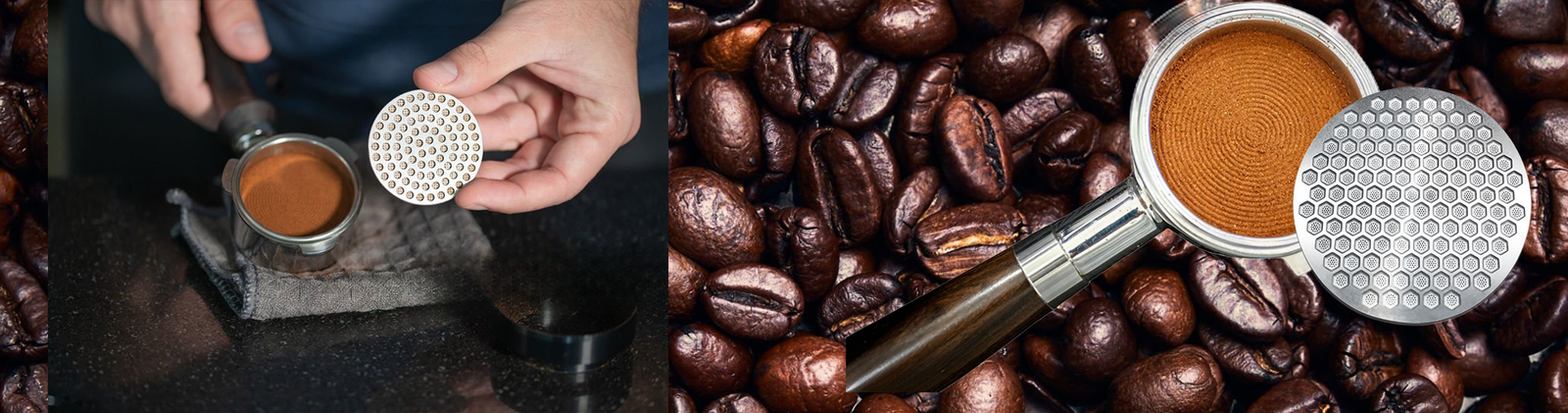
Customizing Your Espresso Puck Screen: Meeting Specific Extraction Needs
n the world of espresso, perfection often lies in the smallest details. One such detail is the espresso puck screen—a thin, precision-etched stainless-steel disc placed above the coffee puck to ensure even water distribution. While standard models work reasonably well, true professionals know that extraction quality varies greatly between machines, roasts, and brewing styles. That’s why customizing your espresso puck screen can make all the difference.
At Caffepress Precision Technology Co., Ltd., we specialize in chemical-etched espresso puck screens engineered to meet the exact extraction requirements of baristas, roasters, and coffee-equipment brands worldwide. This article explores how custom puck screens help unlock flavor potential and consistency across every shot.
Understanding the Role of the Espresso Puck Screen
The espresso puck screen serves as a crucial intermediary between the group head and the coffee puck. Its job is to distribute pressurized water evenly, preventing channeling and ensuring a uniform extraction. The geometry and precision of its holes directly affect water flow, pressure, and flavor balance.
A standard puck screen offers good coverage—but it’s optimized for general conditions. In contrast, a customized puck screen fine-tunes these parameters to suit specific extraction needs: machine type, roast profile, grind size, and even regional water composition.
Why One Size Doesn’t Fit All – The Case for Customization
Espresso machines vary in group head diameter, basket shape, and water-pressure profiles. Roasters and café chains also differ in their brewing philosophies—some pursue bright acidity, others a fuller body.
A customized puck screen addresses these variations by allowing precise control of flow resistance and saturation speed. For example, a barista using a lighter roast may choose a denser hole pattern to slow down the flow and enhance sweetness, while a dark-roast specialist might prefer a more open mesh for faster extraction.
Comparison: Standard vs. Customized Puck Screens
| Feature | Standard Screen | Customized Screen |
|---|---|---|
| Hole Pattern | Fixed layout | Tailored geometry |
| Flow Rate | Generic | Optimized for blend/machine |
| Branding | None | Logo or laser marking |
| Surface Finish | Polished steel | Etched or coated finish |
| MOQ | Readily available | Negotiable with factory |
Key Parameters for Custom Production
When developing a bespoke espresso puck screen, several parameters determine its performance and identity:
-
Diameter & Fit: Standard 58 mm screens fit most commercial machines, but Caffepress also supports 51–54 mm models used by Breville, DeLonghi, and niche brands.
-
Hole Size & Density: Adjusted to balance flow rate, typically between 100–150 µm.
-
Material Options: Food-grade 304 SS for general use or 316 SS for superior corrosion resistance.
-
Thickness & Rigidity: Ranging from 0.2 mm to 0.3 mm, affecting durability and pressure distribution.
-
Surface Finish: Satin, matte, or mirror finish depending on cleaning and aesthetic preference.
-
Laser Logo & Branding: Custom engraving enhances OEM identity for distributors and café chains.
These specifications allow importers and roasters to align design with their brand’s technical and marketing needs.
How Chemical Etching Enables High-Precision Customization
Unlike punching or laser-cutting, chemical etching produces ultra-fine holes without burrs or deformation. The process uses photochemical masks to dissolve material precisely—achieving tolerances as tight as ±0.01 mm.
Caffepress operates a dedicated etching facility in Dongguan with cleanroom-controlled conditions. This enables consistent micro-apertures that ensure stable water diffusion, shot after shot.
From experience, one European roaster customized a 54 mm, 150 µm etched puck screen with tighter hole density. The result: 12 % reduction in channeling and improved crema stability during side-by-side extraction tests.
Moreover, chemical etching is environmentally friendly—producing minimal waste and avoiding the mechanical stress common in laser cutting.
Balancing Performance and Practicality
Customization isn’t only about taste—it’s also about usability and longevity. Choosing the right combination of hole density, thickness, and finish ensures both high performance and easy maintenance.
-
Flavor Clarity vs. Flow Rate: Denser screens yield deeper sweetness but require fine grind calibration.
-
Durability: Thicker etched steel withstands repeated cleaning cycles.
-
Anti-Scaling: Smooth etched surfaces resist residue buildup, ensuring consistent pressure distribution.
-
Compatibility: Each screen must fit perfectly into the portafilter without affecting headspace.
With professional guidance from manufacturers like Caffepress, customization becomes a practical, repeatable process rather than a risky experiment.
How to Work with a Manufacturer on Custom Puck Screens
For roasters and coffee-equipment brands, collaborating with an experienced factory ensures smooth development from concept to shipment.
Step-by-Step Customization Process:
-
Define Extraction Goals – Specify the desired shot time, flavor notes, and brew pressure.
-
Provide Technical Specs – Machine type, basket diameter, and target flow rate.
-
Design & Simulation – Caffepress engineers prepare CAD drawings and flow models.
-
Sample Validation – Evaluate sample extractions and adjust as needed.
-
Mass Production – Confirm order and finalize packaging, branding, and QC inspection.
Typical lead time for customized puck screens is 20 days with an MOQ of 500 pcs, depending on complexity. Every batch is tested for uniformity and passivation safety, following ISO 9001 and SGS standards.
Real-World Benefits for Roasters and Café Chains
Customization directly translates into measurable benefits:
-
Consistency Across Locations: A Southeast Asian café chain standardized its brew results across 80 stores after adopting custom 58 mm etched screens.
-
Brand Reinforcement: Laser-engraved logos on each screen built customer recognition and loyalty.
-
Long-Term ROI: Though setup costs are slightly higher, stable extraction quality reduced wastage and staff calibration time—saving both beans and labor.
These examples show how precision manufacturing supports both flavor excellence and business efficiency.
Conclusion – Precision Customization for Perfect Extraction
When espresso extraction becomes a signature of your brand, small hardware details matter immensely. A customized espresso puck screen lets you translate your coffee philosophy into consistent flavor.
With 15 years of export experience, Caffepress combines chemical-etching precision, OEM flexibility, and global delivery reliability. Whether you’re a roaster, distributor, or barista seeking better consistency, we help you design the ideal puck screen for your specific extraction goals.
Contact our Dongguan factory today to explore custom solutions for your espresso puck screen needs.
Frequently Asked Questions
1. What is an espresso puck screen used for?
It distributes water evenly across the coffee puck, minimizing channeling and improving flavor balance.
2. Can I customize the size and hole pattern?
Yes. Caffepress offers full customization for diameter, hole density, thickness, and logo engraving to match your machine and brand.
3. What materials are available?
Usually 304 or 316 stainless steel depending on the required corrosion resistance and budget.
4. What’s the minimum order quantity?
Typically 500 pieces for custom orders with about 20 days lead time.
5. How does chemical etching compare with laser cutting?
Etching delivers smoother edges and precise hole geometry without heat deformation, ensuring uniform extraction.


